

Autumn Foraging: Nuts, Berries and Fungi Safely
Know the Law Before You Pick
Foraging in Britain is not a free-for-all, but it is far more generous than many people assume. Under the Theft Act 1968, picking fruit, foliage, flowers and fungi growing wild is not theft, provided the harvest is for your own use and you are lawfully on the land. Three things trip people up. First, uprooting any wild plant without the landowner's permission is an offence under the Wildlife and Countryside Act 1981. Second, selling your haul turns a quiet walk into commercial gathering, which needs consent. Third, many individual sites have their own byelaws.
Before you set out, check whether your intended spot is a Site of Special Scientific Interest, a nature reserve, common land, or held by a conservation body. Woodland Trust and National Trust properties commonly restrict picking, and the New Forest caps personal mushroom gathering at around 1.5kg a day. If a sign says no, believe it and find another hedgerow.
Hazelnuts and Sweet Chestnuts
Hazel runs from late August into October. Look for the leaves as much as the nuts: round, doubly serrated and softly hairy, on a shrub that suckers into thickets. The nuts sit in a leafy green husk that pales and frays as they ripen. Squirrels usually get there first, and their signature is a neat, small hole gnawed through the shell. A perfectly round hole is more likely a nut weevil, whose grub has already eaten the kernel.
- Float test: drop shelled nuts into water. Sound kernels sink; hollow or grub-eaten ones float.
- Dry them: spread in a single layer somewhere airy for two to three weeks, turning occasionally, before storing.
- Sweet chestnuts are not conkers. Chestnuts sit in a viciously spiny hedgehog of a husk and have a pointed tip with a small tuft. Conkers come in a leathery case with sparse, blunt spikes and carry a pale round scar.
Berries: Brambles, Sloes and Elderberries
Blackberries begin fruiting in late July and often continue to the first hard frost. Ripe fruit is dull black and comes away with a hollow white core where the receptacle stays on the plant — the opposite of a dewberry. Pick high, above knee height and away from the bottom of hedges where dogs and foxes mark their territory.
Sloes, the fruit of blackthorn, are small, round and blue-black under a powdery bloom, and they grip the tongue with a fierce astringency. Wait for the first frosts, or freeze them overnight at home, to soften the tannins. They make a fine sloe gin, but never eat them raw in quantity.
Elderberries hang in heavy crimson-black clusters on red stems. Cook them thoroughly before eating: raw or underripe berries and the red stalks can cause nausea. Strip the berries with the tines of a fork and discard every bit of green stalk you can see.
Fungi: Slow Down and Be Cautious
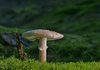
Nothing on a woodland walk deserves more patience than a mushroom. The common field mushroom grows in pasture and rough grass, has pink gills that darken to chocolate brown, a neat ring on the stem and no egg-like sac at the base. Cut one lengthways and check. The yellow stainer looks similar but bruises bright yellow at the base and smells of ink or phenol; it will not kill you, but it will ruin your evening.
- Never trust an app. Use it to narrow the field, then take a proper field guide and verify every feature.
- Take a spore print. Cut the cap, place it gills down on white and dark paper, cover and leave for a few hours. Colour matters.
- Learn the killers. Death cap and destroying angel are white-gilled, grow from a volva at the base and often associate with oak and beech. Cooking does not destroy their toxins.
- If in doubt, leave it out. There is no dish worth the risk.
Pick With a Light Touch
Take no more than a third from any patch, leaving the smallest and the largest to reproduce and spread. Use a basket or a mesh bag rather than a plastic carrier, which sweats and turns soft fruit to mush. Twist berries free rather than wrenching branches, and never trample the ground you are picking from — the mycelium beneath your boots is next year's crop. Avoid roadside verges and sprayed field margins altogether; heavy metals and pesticide drift linger on the fruit.
Keep a Nature Journal
A small notebook will make you a far better forager than any gadget. Record the date, weather, a grid reference and the tree or shrub you picked from, not just the fruit. Sketch the leaf shape, note the smell, tape in a pressed specimen or fold a spore print onto the page. Write down your first hazelnut, first blackberry and first field mushroom of the year, then compare next autumn. These small records sharpen your eye, help you return to a reliable tree, and turn a walk into a conversation with the same few acres that runs year after year.


Tree Lore
-
Hawthorn, blackthorn and hazel create a dense boundary that feeds birds, shelters insects and needs little maintenance once established.
Nature Journaling


-

Long established fact that a reader will be distracted
-

Long established fact that a reader will be distracted
-

Long established fact that a reader will be distracted

Woodland Walks
Karla Gleichauf
12 May 2017 at 05:28 pm
On the other hand, we denounce with righteous indignation and dislike men who are so beguiled and demoralized by the charms of pleasure of the moment
M Shyamalan
12 May 2017 at 05:28 pm
On the other hand, we denounce with righteous indignation and dislike men who are so beguiled and demoralized by the charms of pleasure of the moment
Liz Montano
12 May 2017 at 05:28 pm
On the other hand, we denounce with righteous indignation and dislike men who are so beguiled and demoralized by the charms of pleasure of the moment